Wednesday, August 25, 2010

Top 10 Classic Literature Video Games


Did you know that somebody, somewhere, has turned The Great Gatsby into a video game?! 
'Spend a summer on a jazz-fueled adventure based on F. Scott Fitzgerald’s legendary novel. Experience the Roaring Twenties first-hand as you uncover secrets behind the richly decadent facade. Explore one of the most tragic tales in literary history,' says the spiel.
'...Recreate Fitzgerald’s famous prose, assemble your own library and earn trophies to share with friends on Facebook.'
I have zero interest in gaming but perhaps it's a welcome relief from the bizzare role-play world of Halo: Combat Evolved, Metroid Prime et al.
Discovering the evolution of Gatsby from Penguin Classic to video game console inspired Flavorwire to dream up a list of: 10 Unlikely Classics That Would Make Great Games

Tuesday, August 24, 2010

Best Dressed Literary Figures

Reading an article in the SMH by novelist John Marsden, whose Tomorrow series is apparently epic among teenagers (?) and is on its way to the big screen, I was curious when he said: 'I'm not a visual person. I see words not pictures. I don't notice faces, clothing, hairstyles. There are few descriptions of such things in my books. I can have an hour's conversation with someone I've just met, run into them an hour later and not recognise them.' 
Maybe that's why I haven't read any of his books? The idea that a person can look at something and not perceive some dual impression of form as well as function is incomprehensible to me.
Especially when it comes to characters and their clothes! Today's list comes courtesy of Flavorwire, whose writer Judy Berman had the brilliant idea to nominate Literature's 10 Best Dressed Characters. Bravo! I do admire most of the inclusions and am particularly pleased that Madame Bovary got a guernsey - however it must be said - there are a couple of glaring omissions. 
Where is Anna Karenina
And Marguerite Duras' nameless girl in The Lover, the girl with an imagination that surpasses her grim reality and who goes to school wearing evening shoes?:
"I'm wearing a dress of real silk, but it's threadbare, almost transparent. It used to belong to my mother...It's a sleeveless dress with a very low neck. It's the sepia color real silk takes on with wear. It's a dress I remember. I think it suits me. I'm wearing a leather belt with it, perhaps a belt belonging to one of my brothers...This particular day I must be wearing the famous pair of gold lamé high heels. I can't see any others I could have been wearing, so I'm wearing them...Going to school in evening shoes decorated with diamanté flowers... These high heels are the first in my life, they're beautiful, they've eclipsed all the shoes that went before...
Here's a couple from Flavorwire's list:
In Breakfast at Tiffany's Truman Capote writes of Holly Golightly: “She was still on the stairs, now she reached the landing, and the ragbag colors of her boy’s hair, tawny streaks, strands of albino blond and yellow caught the hall light. It was a warm evening, nearly summer, and she wore a slim, cool black dress, black sandals, a pearl choker. For all her chic thinness, she had an almost breakfast-cereal air of health, a soap and lemon cleanness, a rough pink darkening in the cheeks. Her mouth was large, her nose upturned. A pair of dark glasses blotted out her eyes. It was a face beyond childhood, yet this side of belonging to a woman. I thought her anywhere between sixteen and thirty; as it turned out, she was shy two months of her nineteenth birthday.”
Gustave Flaubert describes Emma in Madame Bovary: “She would come directly, charming, agitated, looking back at the glances that followed her, wearing her flounced gown with gold eyeglass, her dainty shoes, all sorts of elegant trifles that he had never enjoyed, and exhaling the ineffable seduction of yielding virtue.”


Who do you think should have made the cut?

Monday, August 23, 2010

Literary List Week...

This week is Literary List Week on Rubyfire Writes. Cyberspace seems to be full of people making lists - top 50 this, top 20 that, top 3-gazillion something else - so I've been stashing away a few literary lists for your reading pleasure. 
To get you in the mood, take a look at this Huffington Post selection: Nine of the Most Amazing Bookstores in the World. I'm excited to say I can cross three of these off my list of yet-to-see shops and, happily, add to my 'holiday' list an additional six destinations.
In 2008 The Guardian named Selexyz Bookstore in Maastricht, Holland, the best bookstore in the world. This heavenly store is located inside a refurbished Dominican church that dates back to 1294. Wow.
El Ateneo in Buenos Aires, Argentina, was once a theatre named The Grand Splendid (which, in 1929 premiered the first ever movie with sound).
A homegrown entry - Gould's Book Arcade in Sydney, Australia. Bob Gould started selling books in the inner west suburb of Newtown in 1967. Bob has over a millions books and records to sell either in the store, in storage or on line.
'Amazing' means different things to different people. I could add a few, perhaps more humble, bookstores to the list. You tell me yours and I'll tell you mine...!

Saturday, August 21, 2010

The lost muse...


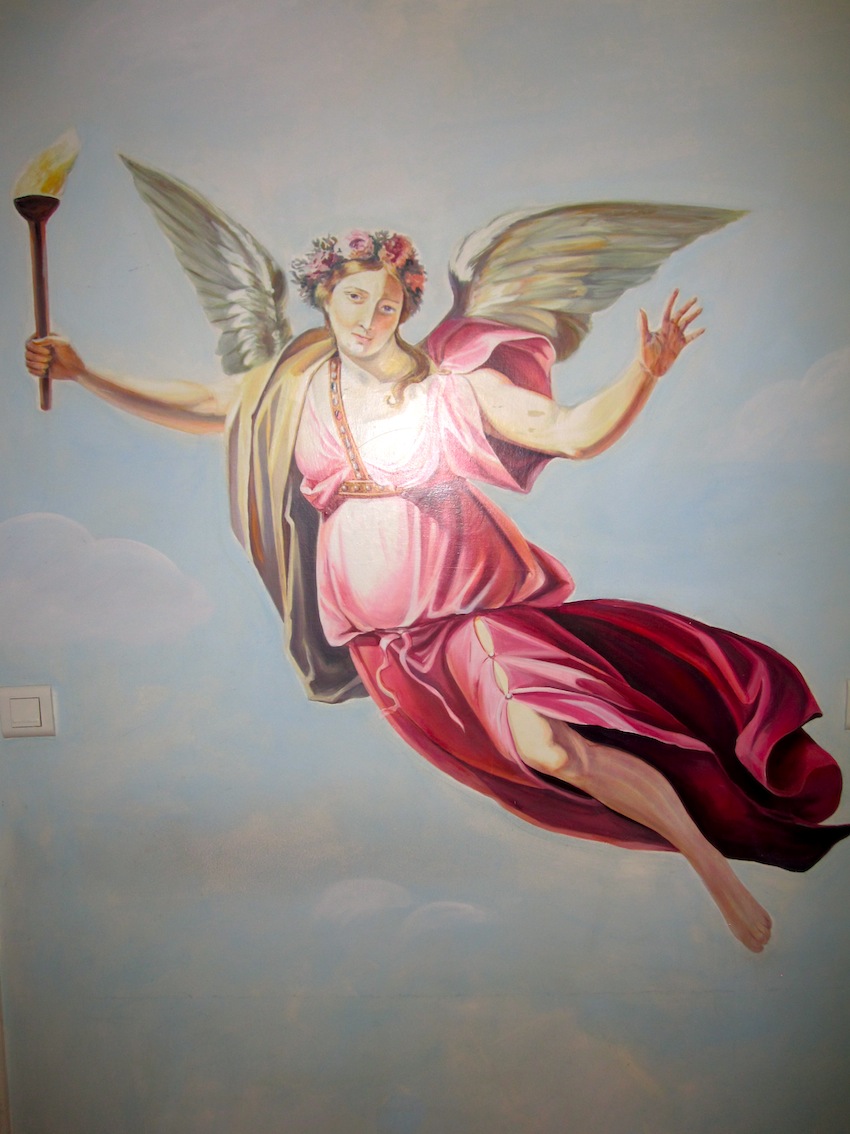
Spent a night in Paris at the Napoleonic era Hotel les Jardins du TrocoderoIn trawling through accommodation options on the web, this one had a distinct point of difference... Yes it was located virtually at the foot of the Eiffel Tower and near the great museums of Paris, yes it had a hairdryer (you may mock, but this is a prerequisite when one is off to a wedding), yes it had air-conditioning (it was 40 degrees outside!), and yes it was decorated with period furniture. But the best feature was this: artists from the École des Beaux-Arts have painted murals of the muses throughout the hotel. Yes!
Imagine my dismay then, when after jumping in and out of the lift to see which muse occupied each floor, I found everyone except the best muse of all...Calliope. She, the muse of heroic poetry - the wisest and most assertive of the nine muses - was nowhere to be found. And sadly, the only place in this lovely hotel entirely lacking in charm was at the front desk. When I asked the manager where Calliope was he gave me a dark stare and a brusque 'I don't know!'.
Sigh.....perhaps he was a wannabee writer too? I guess I'm not the only one in this world calling for Calliope.


Friday, August 20, 2010

Bookshelf porn

Look - a new favourite blog! There's a fresh mouth-watering image posted each day. I especially like one reader's comment:
"Dear people who read Bookshelf Porn, I am sure you are all smart, super good-looking, talented, funny and you probably smell good too."
But of course.
You may wish to divert your computer screen from public view so you can check out these luscious delights in private...


Wednesday, August 18, 2010

French letters

Found these gorgeous old postcards from the 1950s in a tiny shop in the medieval town of Eze, perched on the edge of a soaring cliff above Ste-Jean Cap Ferrat on the Cote D'Azur. 
But what do they say?? Do you speak French? Translation please! 
In the meantime, a thousand different possibilities are weaving tales inside my head...


I have a dream...

This is for my friends meeting tomorrow night at our literary salon session... keep writing keep writing keep writing...let us find out what we know!
Thanks to Coelho Culture for spotting this image.

Sunday, August 15, 2010

Man caves

On the subject of Hemingway yesterday...I came across this picture of his writing room. This is the spot in Key West, Florida, where Hemingway penned For Whom the Bell Tolls and Death in the Afternoon, probably while drinking a Scotch, smoking a cigar and contemplating the mementos he collected from his adventures in Africa and Cuba. Hemingway converted an old carriage house on his property into this writing studio. Note his famous Royal typewriter on the desk.
Also found two photos of Mark Twain's man cave high atop a hill on his sister's property in Elmira, New York. In this sanctuary Twain wrote Life on the Mississippi, A Connecticut Yankee in King Arthur's Court, and Adventures of Huckleberry Finn. In 1874 he described his writing hut in a letter to William Dean Howells:
It is the loveliest study you ever saw…octagonal with a peaked roof, each face filled with a spacious window…perched in complete isolation on the top of an elevation that commands leagues of valley and city and retreating ranges of distant blue hills. It is a cozy nest and just room in it for a sofa, table, and three or four chairs, and when the storms sweep down the remote valley and the lightning flashes behind the hills beyond and the rain beats upon the roof over my head—imagine the luxury of it.
I love my writing room too. It just needs thousands more words to spill out of it...

Saturday, August 14, 2010

Long live livres anciens

In the footsteps of Hemingway, F Scott Fitzgerald, Ezra Pound and friends wandering through the muddled streets of Faubourg Saint-Germain-des-Prés on a summer saturday in Paris... bookstores galore and a moveable feast of ancient articles de valeur to admire...


Thursday, August 12, 2010

826 Valencia

I have a crush on Dave Eggers. Sigh. His list of literary accomplishments is one thing; his life story-so-far - a tale of heartbreak, resilience and aspiration - is another; but the real clincher for me is 826 Valencia.
826 Valencia is a writing studio in San Francisco dedicated to supporting kids between the ages of 6 and 18 with their writing skills and helping teachers to get their students fired up about the literary arts.
Eggers and his mate Ninive Clements Calegari founded the centre in 2002, which has grown since then to include seven chapters across the United States, under the not-for-profit umbrella 826 National.
Some of the great things the Centres offer kids are writing workshops, drop-in tutoring, field trips and student publishing in all kinds of formats and new media.
Field trips you may ask? They sound really cool - check this out:
"Storytelling and Bookmaking
This is our most popular field trip. Students are charged with the task of writing, as a group, a story, with the help of 826 volunteers. While the students decide on character and plot points, an 826 volunteer is typing the story into a computer, which is projected onto the wall. The students can track the story’s progress, and make corrections as needed. Meanwhile, the story is being illustrated by a professional artist. As the pages are finished, they’re being copied — one set for each student — and collated in our back production room. Thus, as soon as the class finishes creating the story, we’re ready to bind the books with our in-house tape bindery. The students illustrate their covers, add their photo to the back (for an About the Author page), and go home with personalized books created as a class. This field trip teaches students about collaboration, self-editing, the bookmaking process, and elements of successful storytelling. And it’s really a good time for all. Recommended for students 7–11 years old."
Sounds awesome. I want to go! (Even if Dave himself can't make it..)
Oh, and the San Francisco Centre also has a Pirate Supply Store, perfect for those swashbuckling, seafaring essentials every great storyteller needs.

Tuesday, August 10, 2010

Updating Blyton a blight on the next gen?


Seventy years on, six feet well and truly under, Enid Blyton can still stir up a frothy conversation. Bravo! 
Outrage and dismay, it's fair to say, were the order of the day after making mention of publishers in England updating ten of Enid Blyton's fabulous Famous Five adventures. In an effort to make them more palatable to the fickle appetite of Gen-whatever-we're-up-to-now, it's goodbye to 'fancy that!' and 'splendid idea George, what a brainwave!' and hello to the dumbed-down 'wow' and 'ok George'.
Comments on Saturday's post sprang to mind today when I came across this observation from the German philosopher Arthur Schopenhauer, on the decline of Latin as the language of scholars in the early 1800s.
He said that turning to writing in one's mother tongue, instead of Latin: "excommunicated modern scholars from the benefits of belonging to a universal community of scholars that was not restricted by the contingencies of time and place of birth. 
"By reading Latin, not only was it possible to enjoy the thoughts and insights of Roman antiquity, but one could become acquainted with Scotus Erigena of the ninth century, John of Salisbury of the 12th, and Raymond Lull of the 13th, and hundreds of others, something that could not have been the case had they written in their native languages.
"Without preserving Latin, moreover, and by not writing in Latin, one's own works could not speak to future scholars.
"...There was also the loss of the humanising effects of Latin authors, which followed from the decline in the knowledge of Latin. The humane and honest ways in which classical writers considered the individual, the community, and nature were natural tonics for the pernicious and stupefying effects of the Middle Ages, with its...half brutal, half idiotic chivalry from which modern society still suffered."
Ouch. He goes on to say that the use of national languages - which disseminated the work of scholars across a broader audience - also served to dilute the population of serious readers.
Therein lies the double-edged sword. 
Translating, updating, modernising etc serves to increase the reach and, therefore, influence of a classic body of work, but in doing so runs the risk of diminishing its value because it's received by an audience that possibly isn't well enough equipped to understand or appreciate its true worth.
A case in point.  Tony Summerfield, who runs the Enid Blyton Society, commenting in  The Guardian said that he is "thoroughly against unnecessary changes just for the sake of it, from adults who underestimate the intelligence of children."
On hearing that publishers intended to change the name of the circus boy, Nobby, in Five Go Off in a Caravan to Ned, Summerfield was dumbfounded. 
"How can you change Nobby to Ned and yet leave Dick and Fanny? It doesn't make sense."
Indeed. 
So, what the next Gen makes of Julian, Dick and Anne, George and Timmy the dog remains to be seen. Anyone have an age appropriate crash test dummy to experiment on? 
And, can anyone you know speak Latin these days?


Monday, August 9, 2010

Trove...discover Australian treasures

On the hunt for information about the life of a Northern Territory bull rider, I came across a great web search service offered by the National Library of Australia. With direct access to its wealth of archives, Trove searches hundreds of thousands of records that regular search engines won't find.
It's well worth a look if you're searching in the fields of literature, social sciences, local or family history, or anything really that involves noteworthy Australians. It'll produce results in formats such as newspaper articles, descriptions of people, books relating to them, pictures, biographies, music, oral histories, manuscripts and maps.
Trove even says it can help students with school assignments. There you go kids, straight to the top of the class.
Browsing through various authors, I was directed to a local website that sources out of print and collectible Australian books, which can be tricky to find on the big international sites. If you're after something elusive, check out BibliOz.
And yes, I found my bull rider, pictured above (courtesy of the Northern Territory Library) at the Brunette ABC Race Meeting and bull sale in 1953. I bet he has a million stories to tell...

Uppercase

Am liking these two pics I found today on the Uppercase web journal. 'All the forces in the world are not so powerful as an idea whose time has come.' - Victor Hugo. Photo taken at the Levi's Workshop in San Francisco.
And an illustration by artist Jing Wei, whose work features in the current issue of Uppercase.