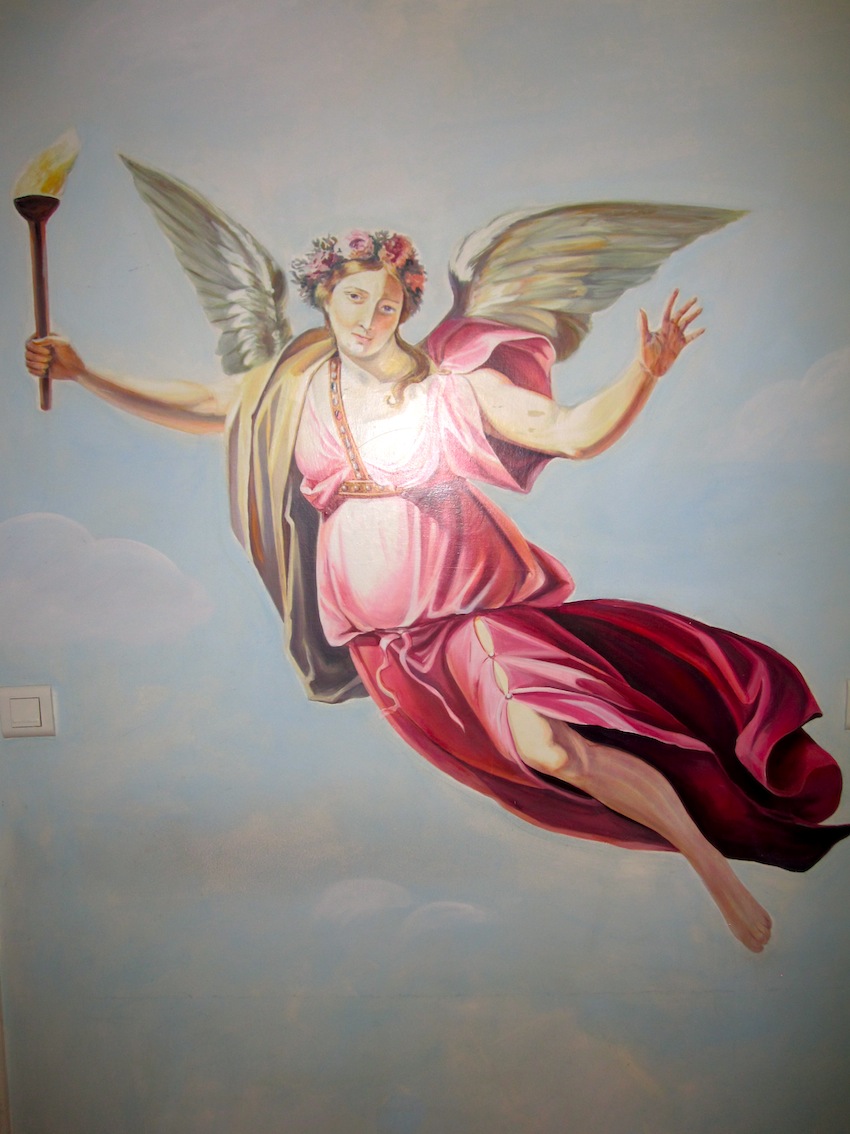
As lovely as they are - Clio, Euterpe, Polyhymnia et al - I'm still searching for Calliope...!
Spent a night in Paris at the Napoleonic era Hotel les Jardins du Trocodero. In trawling through accommodation options on the web, this one had a distinct point of difference... Yes it was located virtually at the foot of the Eiffel Tower and near the great museums of Paris, yes it had a hairdryer (you may mock, but this is a prerequisite when one is off to a wedding), yes it had air-conditioning (it was 40 degrees outside!), and yes it was decorated with period furniture. But the best feature was this: artists from the École des Beaux-Arts have painted murals of the muses throughout the hotel. Yes!
Imagine my dismay then, when after jumping in and out of the lift to see which muse occupied each floor, I found everyone except the best muse of all...Calliope. She, the muse of heroic poetry - the wisest and most assertive of the nine muses - was nowhere to be found. And sadly, the only place in this lovely hotel entirely lacking in charm was at the front desk. When I asked the manager where Calliope was he gave me a dark stare and a brusque 'I don't know!'.
Sigh.....perhaps he was a wannabee writer too? I guess I'm not the only one in this world calling for Calliope.
Have you ever read the interview section in the Sydney Morning Herald's Good Weekend magazine where they ask a personality a standard set of quick questions?
There's one that goes something like: "It's not trendy but I love...?"
My answer would be "it's not trendy but I love the epic poets".
And they're the reason the whole 'Muse' thing began. There are some brilliant stories within the lyrical language of the ancient poets.
Homer wasn't one to mince words. OK so his Odyssey is pretty long (epic, in fact) but in the oral tradition of the times it was intended to be sung rather than read - and being the 8th century BC think 'entertainment' rather than 'academia'. Odyssey tells the story of Odysseus' 10 year journey home following the fall of Troy - a loaded tale - so it makes sense that Homer invokes the muse right off the bat in the opening line:
"Sing to me of the man, Muse, of twists and turns driven time and again off course."
About 10 lines into The Aeneid, after defiantly stating his independence, Virgil sought help (rather frustratedly by the sounds) from the deities :
"O Muse! the causes and the crimes relate;
What goddess was provok'd, and whence her hate;"
Shortly after Homer and Virgil, a third heavyweight showed up. In his poem Metamorphoses, Ovid pretty much describes the history and creation of the world in 15 volumes. And with such a mammoth task it's no wonder he opens with a plea for divine inspiration to the Muses:
"Of bodies chang'd to various forms, I sing:
Ye Gods, from whom these miracles did spring,
Inspire my numbers with coelestial heat;
'Till I my long laborious work compleat:"
So my point is, the original purpose of the muse was to create insights and inspire new artistic forms. To call upon a higher power to help unleash the limitless potential of the individual.
But if you think about the modern day muse - the painter's latest infatuation, or the famous supermodel fashion designers aspire to dress - it's all about inspiring imitation. Creating something in the mould of someone else.
That's one reason why I love the epic poets. Those guys were way ahead of their time. They were true, great, original thinkers. We need a few of those kind of people in the 21st century. Any contenders?
NB. A case in point. When you google search images of Homer, you get about a million pictures of Homer...Simpson.
I'm thinking about muses. You know, the nine Greek Goddesses who inspired the creation of literature and the arts: Clio, Thalia, Calliope, Erato, Euterpe, Melpomene, Polyhymnia, Urania and Terpsichore.
More specifically, I'm thinking about modern day incarnations of the muse.
At some point between Ancient Greek and contemporary times, the muse morphed from being an invisible, spiritual deity into a living, breathing (mortal) seductress.
Take Pablo Picasso as an example. He famously anointed each woman he loved, and who became his subject, as his muse.
Here in Australia during the 1930s, '40s and '50s, the art fraternity appeared willing to share one's muse. Sir Sydney Nolan and Albert Tucker both claimed arts patron Sunday Reed as their muse, an arrangement she, apparently, also found most agreeable.
But there was one 20th Century dude I can think of, Jim Morrison (he of The Doors), who harked back to the Classical world and said his musical inspiration was fed by the spirits.
Swiss psychiatrist, Carl Jung wrote that the muse represents the male's anima: "Immortal". She is "disguised under the many names we give to creative impulses and ideas."
Francine Prose (so aptly named) laid out the purpose of the modern muse in her book The Lives of the Muses: Nine Women and Artists they Inspired.
"Artists rarely create for the Muse, to win or keep the Muse's love and admiration, but rather for themselves, for the world, and for the more inchoate and unquantifiable imperatives of art itself. Their muses are merely the instruments that raise the emotional and erotic temperature high enough, churn up the weather in a way that may speed and facilitate the artist's labors."
Which brings me to ask:
How to invoke the muse? What's the difference between a muse and someone whose influence in some way shapes your craft? And why, in the age of all things supposedly being equal, is the muse still typically female? Who can we women creatives call upon for inspiration in the absence of the male muse?
And well may you ask - who cares?
Creatives care, because inspiration and motivation is the fuel that keeps the writer / poet / artist powering through to complete their work. And if we don't know where the fuel comes from, we can't get more when we run out.
So bear with me while I keep musing on the muse...there's a work of fiction within that's reliant upon a long and steady supply of fuel.
*Apollo and the Muses (above), Simon Vouet, c. 1640